Chapter 2 Linear Regression Models
A regression model is a model for the conditional expectation of the response/outcome variable given a set of predictors/features. A linear regression model specifically assumes that \(E(Y \mid \mathbf{X} = \mathbf{x})\) is a linear function of the inputs \(X_1, X_2, \ldots, X_p\), i.e.,
\[E(Y|\mathbf{X}=\mathbf{x}) \sim \beta_0 + \beta_1 X_1 + \ldots + \beta_p X_p\]
To describe the properties and characteristics of the multiple linear regression (MLR) model, we introduce the Birthweight example.
Introduction to the Birthweight Example
The goal of the birthweight study is to predict the birthweight (response/ outcome) of a newborn baby given a set of predictors/features, specifically for babies born prematurely.
The features include baby-related characteristics, such as length, weight, head circumference, gestation period, and parent characteristics, such as mother’s/father’s height, smoking habits, mother’s pre-pregnancy weight, mother’s/father’s age, etc.
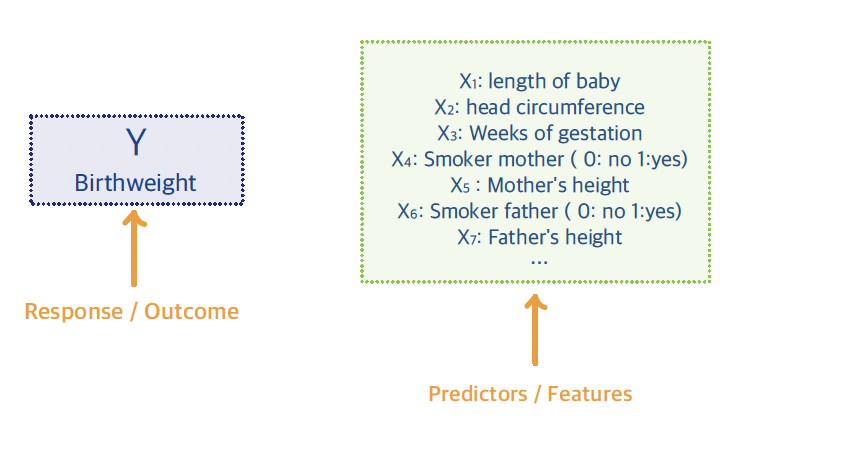
The predictors we consider may be:
quantitative, such as length, weight, or gestation period;
qualitative/categorical, such as smoking habits (yes/no); or
transformations of quantitative inputs. Examples include power transformations (e.g., \(X_3^3\)), continuous functions of variables (e.g., \(\log X_5\)), polynomial expansions (e.g., \(\sum_{k=1}^{n} c_k X_7^k\)), and interactions (e.g., \(X_1 \cdot X_2\)).